

We're great at documenting decline and surprisingly bad at understanding recovery
Recovery, rewilding, and why we're measuring the wrong things (Nexus Notes #30)


I’m travelling back from two weeks in Europe. What a special time it was. I spent a week in the beautiful Spanish Pyrenees discussing how to make ecology more predictive, then I spent a couple of days reconnecting with old colleagues and making new friends at the World Biodiversity Forum in Davos, Switzerland.


Onto this fortnight’s signals.
I.
Signal of the week.

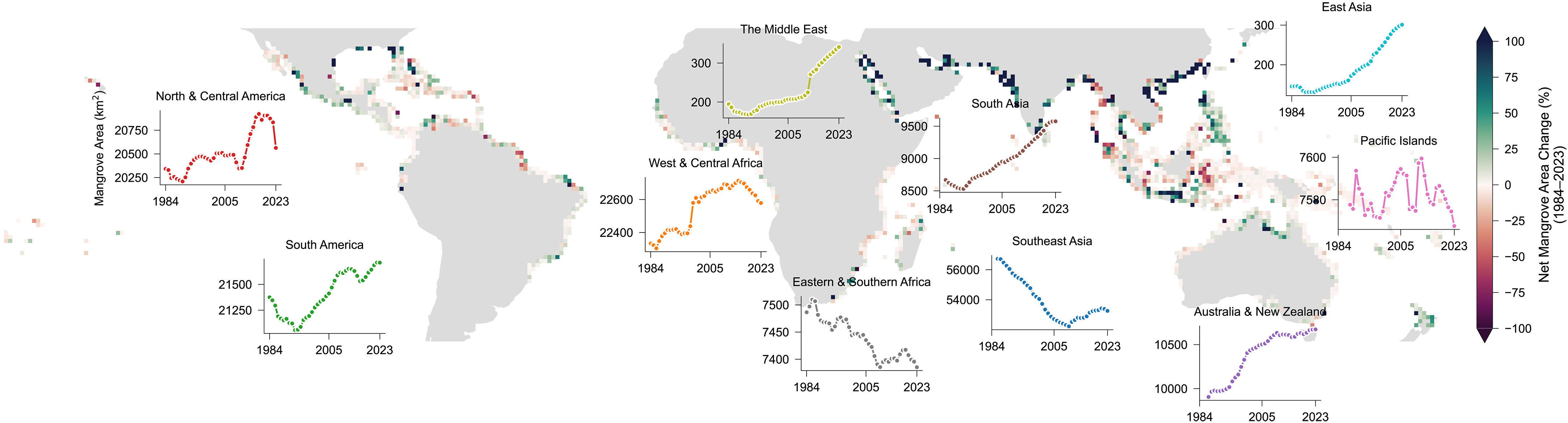
Mangrove forests are healing after decades of human destruction (HT Jackie Feather). Recovery is possible, and happening! A new study analysed 40 years of satellite imagery and found a shift from net loss to net gain in global mangrove extent since around 2010, but patterns are highly region specific as the below figure shows.
As I point out in the below post, mangroves are excellent at sucking up and storing carbon. But they’re also extremely important for coastal flood protection and as a nursery for other species. They’re what’s known as a foundation species (see below).

II.
Speaking of foundation species, they’re dominant organisms like trees, corals, kelp, and mangroves that structure ecosystems and support other species.
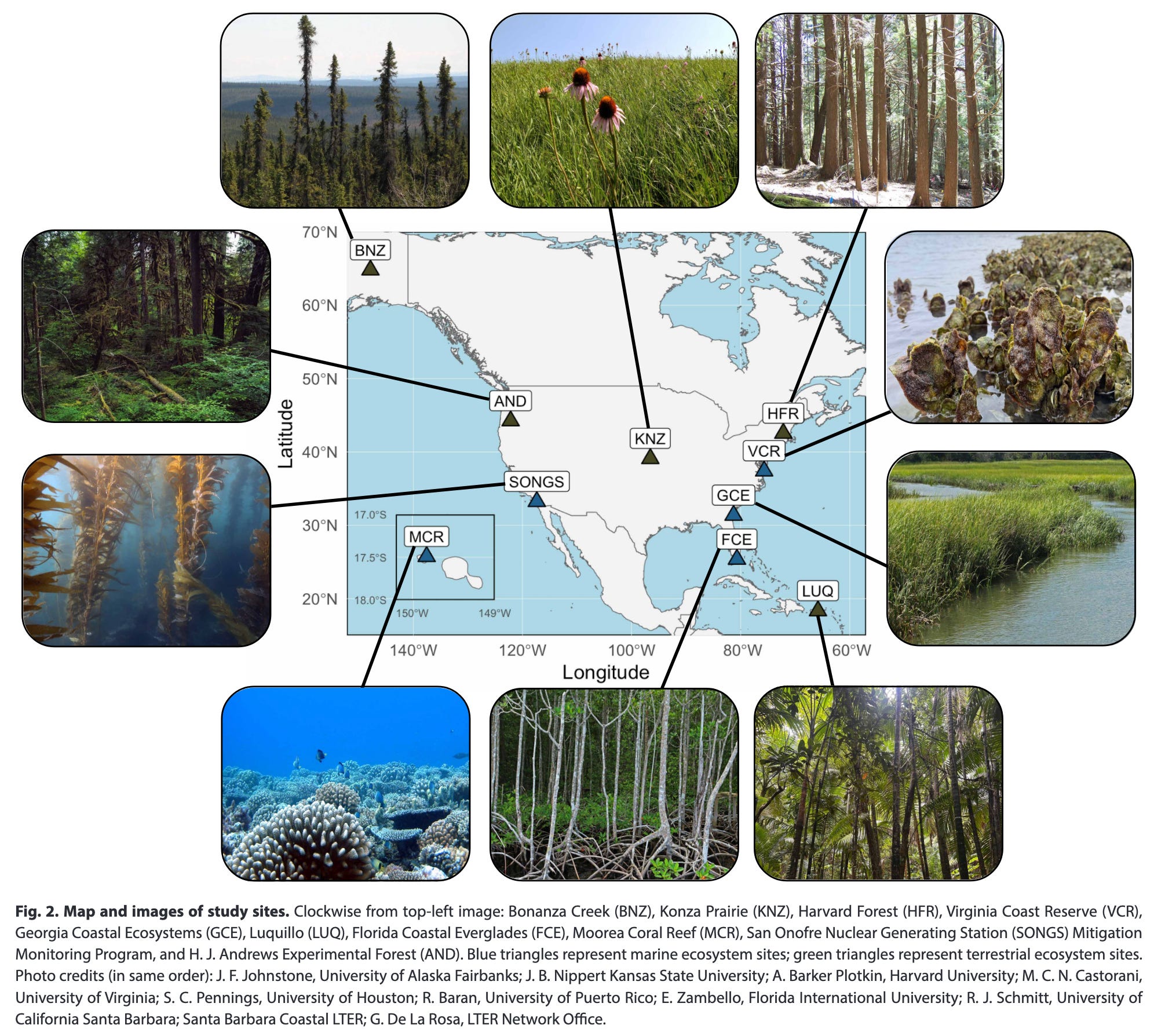
When they die, they leave behind material legacies that can continue to provide resources and habitat. A new study emerging from the US Long-term Ecological Research Network has highlighted these legacies of dead foundation species can strongly influence the recovery of ecosystems. We know foundation species are important for other species in the community, but their study showed that dead foundation species can impact their own success following disturbances, ranging from a 50% reduction to a 12-fold increase in demographic processes like seed release, survival, and recruitment (arrival of new individuals through reproduction). For example, standing dead hemlock trees supported more colonising hemlocks and more seeds were released into soil when greater densities of burned trees remained standing post-wildfire in boreal forests. By contrast, following a marine heatwave dead branching coral skeletons increased live coral decline, and accumulated unburned litter in tallgrass prairies reduced regrowth from belowground biomass compared to unburned sites.
Material legacies are therefore not passive leftovers, but can actively shape how communities recover following disturbance.
III.
Marc Cadotte reflects on the damaging consequences of global political instability on academic collaborations and productivity. International collaborations are being impacted by geopolitical conflicts. As he points out “… unfettered freedom to voice one’s opinions in academia is in direct conflict with policies that limit international collaboration.” His final paragraph says it all:
“Academics often help guide thought and debate on difficult or sensitive issues. There is a reason that totalitarian governments, eager to avoid dissent, purge academics. Research collaboration, academic exchanges, and the pursuit of knowledge should continue to be a beacon during difficult times. If institutions impose restrictions, we limit these opportunities.”
IV.
Biodiversity loss will decrease the future creditworthiness of nations.
New research suggests that financial markets are systematically under-pricing nature-related risks. This has major implications for public finances, nature and financial stability. Economic activity is dependent on natural ecosystems (approximately half of GDP is moderately or highly dependent on nature), but sovereign credit ratings ignore risks to environmental degradation. Indeed, biodiversity-finance policy has always tended to lag behind climate issues.
Here, the authors studied how biodiversity and ecosystem service loss impact financial risk for sovereign debt, and found that across the 23 countries in their study, annual interest payments could increase by US$162 billion. Four countries could face GDP losses of more than 15% by 2030.
V.
Maps reveal where conservation land could be sold off after government reforms.
In my newsletter, I talk a lot about short-term thinking. This move by the New Zealand government is about as good an example of short-term thinking as you can get. Privatisation of national assets has not gone well for NZ in the past — I’m not sure why they think it will this time.
“Forest & Bird, which has produced detailed maps of potentially impacted areas, says New Zealanders will be “furious” over the plans.”
This is exactly the kind of short-term thinking I write about here — trading long-term ecological wealth for immediate returns. If you're a Kiwi, your voice matters on this. Who is speaking for our grandchildren and our grandchildren’s grandchildren?
VI.
“I’ve come to see the lack of model validation in ecology as shocking and embarrassing” — Peter Adler.
Over at Dynamic Ecology, Peter Adler discusses the challenges associated with understanding modern coexistence theory in ecology. What caught my attention was his discussion of the major issues we face with lack of validation in ecology. Our workshop in Spain was focused on moving towards a more predictive ecology and lack of validation was one of the key hurdles we need to overcome.
VII.
Number of the week
7.6 — The percent increase in hydrologic whiplash events between 1975 and 2015.
Driven by climate change, sudden swings between wet and dry create “hydrologic whiplash”, which I wrote about last year. As the temperature warms, the air can hold more water, so it becomes thirstier.
Now, because of greenhouse gas emissions, virtually every place on Earth is heating up, meaning that the air holds more water. In humid periods, when the air is loaded with water, that means more rain. And in dry periods, when warm air isn’t saturated at 100% humidity, it’s thirstier to suck water out of the environment, which can lead to drier dry periods and more drought. “So anywhere with a little water to evaporate, it will evaporate faster,” Swain says, including out of soils, plants, and reservoirs. That can lead to extreme dry periods, causing drought and wildfire.
And these can have massive consequences on ecosystems but we’re only just coming to understand these. As I’ve highlighted before, compound extreme events, can amplify the impacts on ecosystems.
The key for me is the challenge of predicting these events and their impacts. When models are trained on historical data it’s much harder to accurately predict such anomalous events. This makes reservoir management a particular challenge. Water managers are tasked with the near impossible task of balancing flood risk with drought risk. When storms come, they need to release water to avoid catastrophic floods, but if they release too much they risk shortages if droughts follow. Advances in forecasts are helping to improve reservoir operations in California through a greater understanding of atmospheric rivers that cause many of the greatest deluges.
VIII.
30x30 sounds good. It’s ambitious but achievable, and it’s measurable. But is it enough? Jonas Geldman asked whether the 30x30 goal is really enough to achieve the biodiversity goals we are aiming for. I’ve talked about 30x30 before — protecting 30% of the land and ocean by 2030 as part of the Kunming-Montreal Global Biodiversity Framework. 30x30 isn’t the only part of Target 3 though, which calls for “well-connected and ecologically representative systems of protected areas and other effective area-based conservation measures. . . effectively and equitably managed”. Yet, “30x30” coverage has been the defining feature of Target 3. This area focus has in some cases come at the cost of protecting the right things in the right places in the right way. It’s the representativeness and connectivity of protected areas that matters most. And as I mentioned previously, there are also costs to local communities if not done carefully. A stocktake towards these goals is currently ongoing — it’s imperative that the representativeness of protected area coverage is considered, not just total coverage. Let’s not chase the wrong metric!
IX.
Around 120 million hectares of primarily agricultural land has been abandoned in Europe over the past 30 years — a trend well represented in Mediterranean regions. This presents an opportunity for ecological recovery.
Using a chronosequence approach (inferring long-term change by comparing sites abandoned at different times), Pato et al. tracked woodland recovery across 118 plots spanning 75 years following abandonment. Recovery was often slow — taking decades to reach late-successional structure, particularly in harsher Mediterranean conditions. But it was faster in north-facing, moister areas near remnant forests.
The key lesson: recovery is highly context-dependent. Tracking recovery is therefore imperative to learn the processes and characteristics that may speed up regeneration in passive rewilding contexts, particularly when recovery times exceed planning horizons.
That’s the deeper problem running under several of today’s signals — we’re very good at documenting decline and surprisingly bad at understanding recovery. That’s what I dig into below, prompted by a keynote I saw this week that reframed the whole question for me.
Going deeper
Most of this information is publicly available. What’s not is the time to read it all, connect it, and figure out what matters. That's what I do below.
Something that struck me during the conference was just how much potential there is for positive change. Becky Chaplin-Kramer gave an inspiring and uplifting keynote on the need to better understand successful recovery stories. We’re great at celebrating conservation and restoration successes but poor at actually understanding why they succeed.
Most of what we do in ecology is document declines. As I’ve mentioned before, all this negativity can take its toll. And the data support this — there are eight times more papers documenting biodiversity losses than there are gains.
