

Ecological complexity—and the erosion of scientific capacity
How humans reshape ecosystems, and why eroding scientific capacity makes understanding that harder (Nexus Notes #29)

I'm just back from the Society for Freshwater Science annual meeting in Spokane, WA, followed by a few days working on a new paper at the University of Washington field station on San Juan Island. We were developing something that expands on one of my earlier posts — more on that when it's further along. Onto the signals.
I.
Signal of the week.
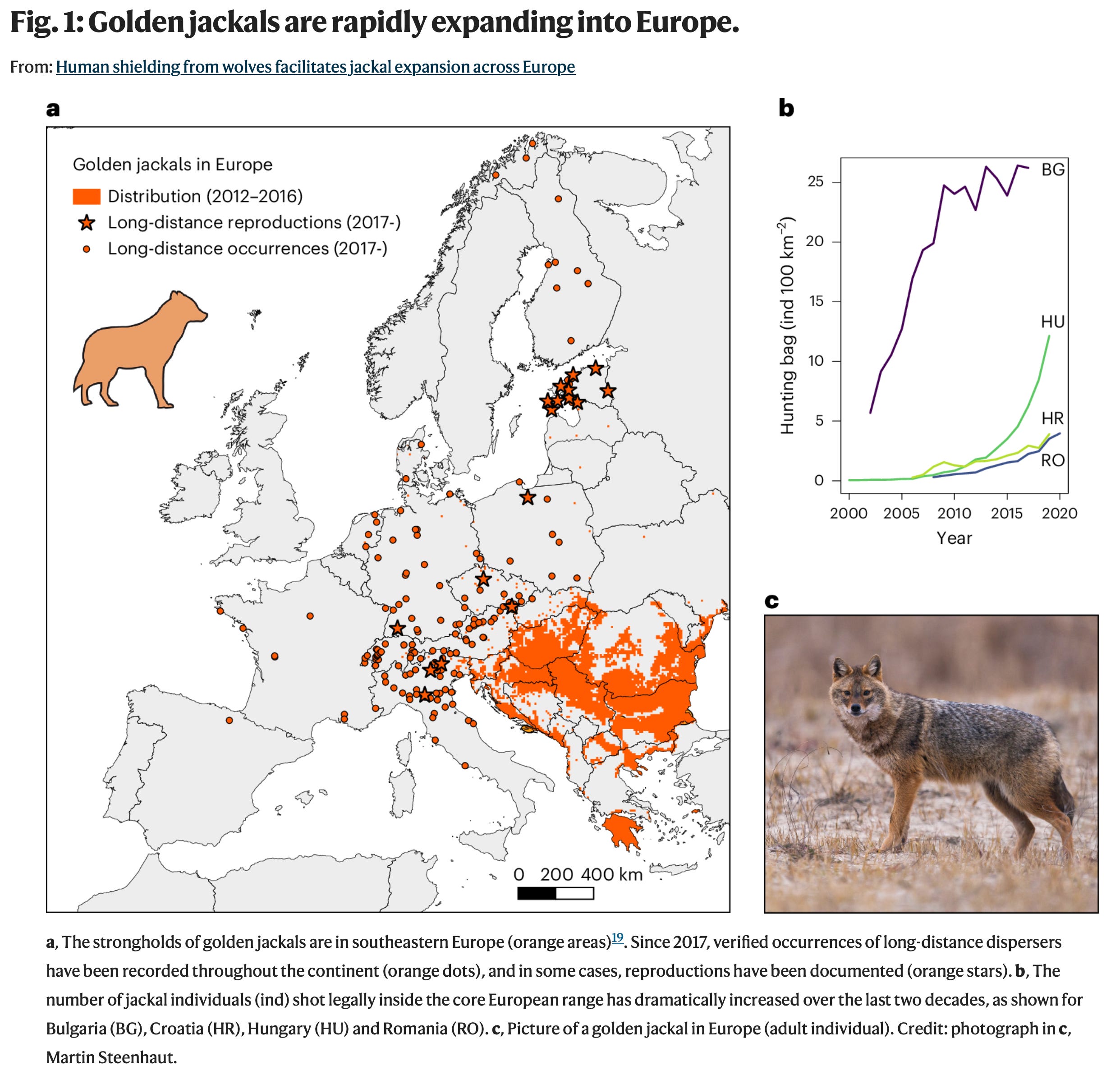
Human shielding from wolves facilitates jackal expansion across Europe. An interesting piece in Nature Ecology & Evolution highlighting the role humans play in mediating interactions between species. Golden jackals have been expanding across Europe. Meanwhile, grey wolves are also recovering, which — as a key predator — should suppress their expansion. However, humans play a shielding role by suppressing wolves near people, dampening their ability to limit jackal expansion. Nature is complex — not only do conservation outcomes depend on species interactions, but also on how we as humans shape those interactions, often not by choice.
II.
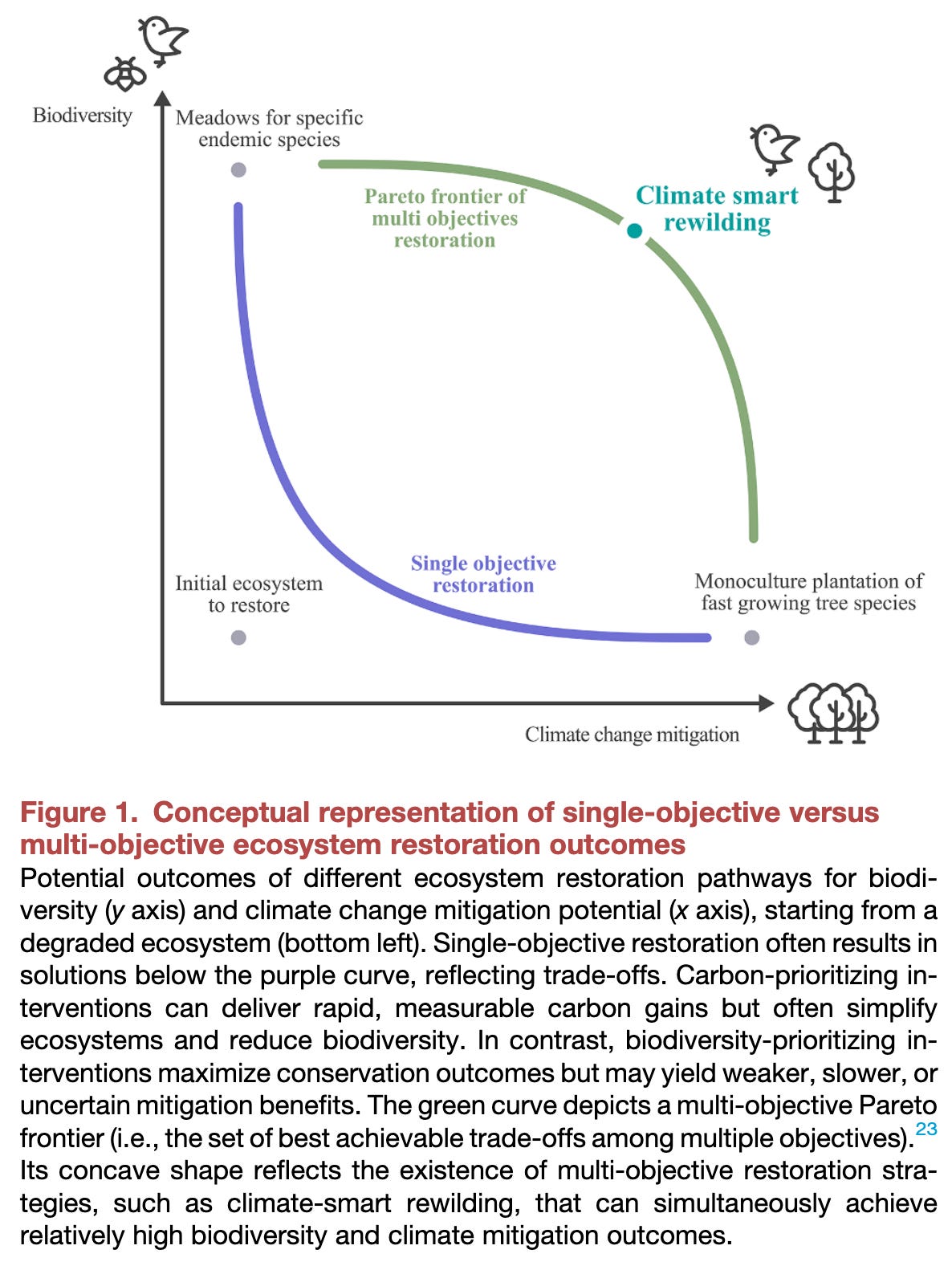
Speaking of human-nature relationships, last issue I talked about how the 30x30 strategy could impact local communities. This piece, titled “Toward climate-smart rewilding: An integrated framework for biodiversity, climate change, and society”, considers the various co-benefits and tradeoffs associated with rewilding. Climate-smart rewilding integrates biodiversity recovery with climate mitigation, climate adaptation, and socio-economic considerations. This paper uses Europe as a case study to explore how these co-benefits and tradeoffs play out in practice. In earlier posts, I’ve talked at length about the costs of large-scale tree planting if poorly planned, and the need for careful reforestation. Here, the authors show that, when done well, rewilding can balance these tradeoffs to deliver multiple benefits.
III.
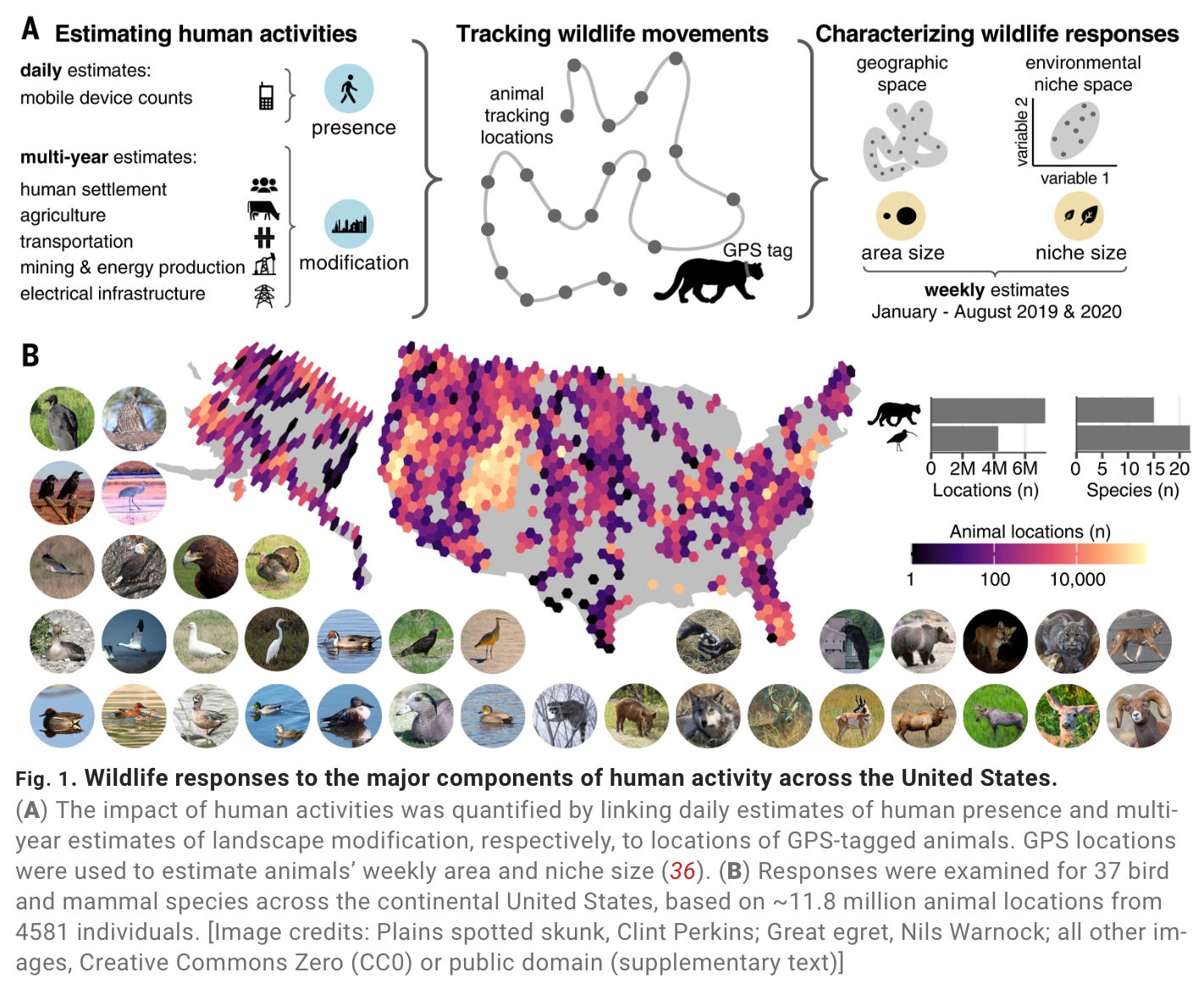
More on human-nature coexistence. This study used mobile device data and vehicle count data to measure human presence, and GPS data to track thousands of animals. They found both human presence and human modification of landscapes impacted the movements of 37 mammal and bird species across the US. Human presence affected almost two thirds of species, and for many of those, animals reacted more strongly to human presence in more natural areas. The human footprint on nature is wide and nuanced — even in relatively natural areas, our presence can be strongly felt. Associated news story and perspective.
IV.
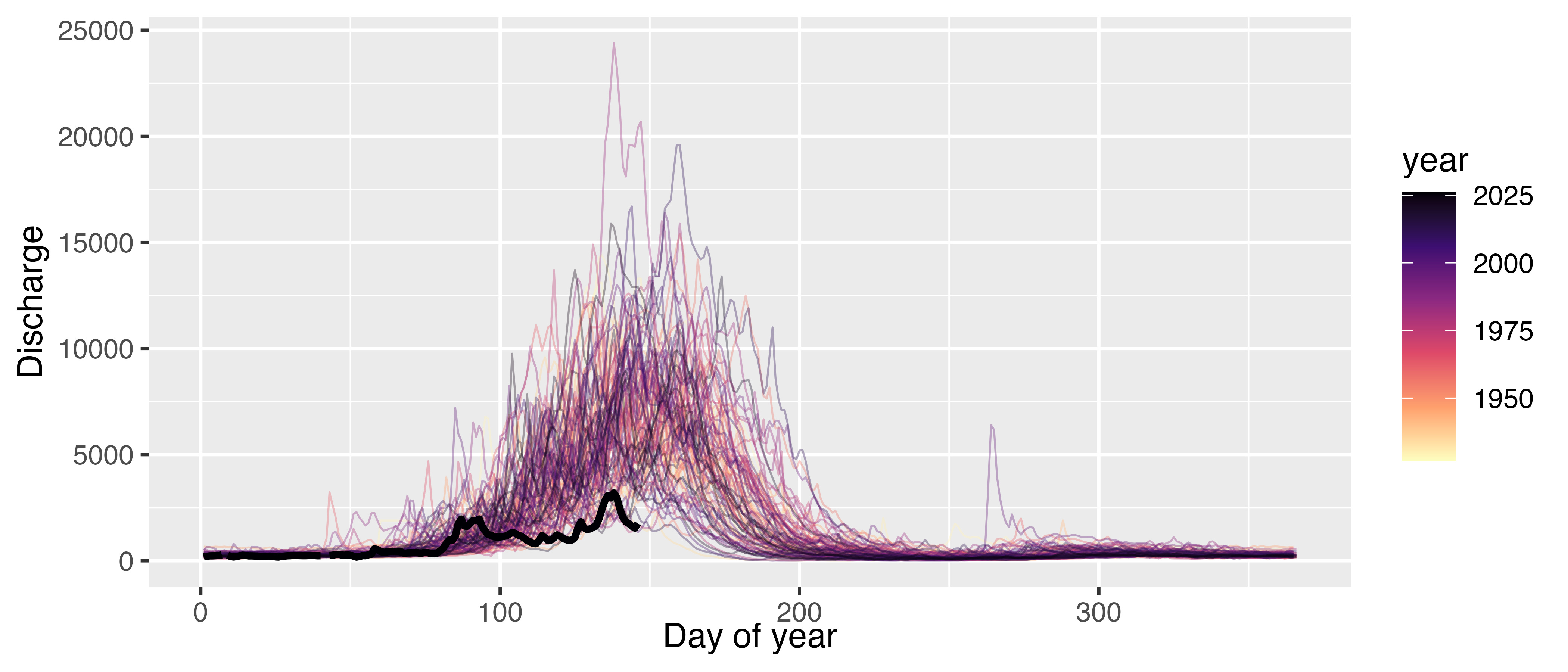
I reported on the record low snowpack in the Colorado in a recent post, emphasising its important role as a seasonal cue for biodiversity. Well, now Utah has entered into State of Emergency for drought associated with this ‘no-pack’ winter. Extreme conditions are being felt across 22 of the 29 counties in Utah and the state’s water supply depends almost entirely on the snowpack. I recently showed what this looks like for river flow in the Yampa River, CO. Here’s an updated plot.
Not all ecological change is loss, though. When pressures are removed, recovery can be rapid, as the below signal shows.
V.
“What we’re seeing now is evidence of an ecosystem beginning to reorganise itself after that pressure was removed.”
Ecosystems can respond if given the chance. Lord Howe Island is bouncing back dramatically following the removal of invasive mammals. I’ve always wanted to go to this island, halfway between Australia and New Zealand. It was hammered by invasive rats and mice following colonisation. But their removal has seen its unique fauna respond rapidly. As I pointed out last year, invasive species don’t just prey upon native species but can completely alter ecosystems from impacting the health of populations through to even altering the climate locally.
VI.
“But for Patil, the 80-year-old farmer in Jambhali, the loss is not only financial. It is the erosion of a system he spent his whole life learning. There was a time, he recalled, when harvests were so abundant that there wasn’t enough space in the house to store grain.
Now, he says, even getting enough to eat twice a day feels sufficient.”
Seasonal patterns that farmers trusted for generations have suddenly turned unpredictable. This piece reflects on how climate change is altering the seasons and affecting crop production, which is particularly impacting small-scale farmers. I was happy to provide some thoughts based on our paper in Science last year, which outlined the ecological consequences of seasonality change.
VII.
“The work ahead is not to repair nature’s purposes, but to take responsibility for our own – and for the world they shape.”
An interesting reflection from John Drake on reframing our understanding of ecological functions and malfunctions. He reflects that “ecosystems don’t exist to perform goals”. Ecosystems just exist. We put these ‘functions’ on them because there are things we like them to help with, such as providing climate stability, food, or fun. It’s a long read, but a nice reflection on ecology and values, and the fact that malfunctioning ecosystems only makes sense from a human-defined perspective of what they are ‘supposed to do’.
VIII.
I don’t know about you, but the topic of biodiversity finance can be quite a minefield to navigate. A new review paper explores return-seeking biodiversity finance mechanisms for financing positive biodiversity outcomes, including raising money for investment in conservation or restoration (loans, bonds and equity) or generating revenues that are linked with biodiversity outcomes (credits). Whether private finance is required for delivering global biodiversity goals is a contentious topic. This paper outlines the practical commercial, ecological and social risks associated with these investments. One thing is clear: investor returns are needed but oversight is critical to ensure ecological and social outcomes. And private finance is just one piece of the puzzle — public investment and philanthropy remain central to moving things in the right direction for biodiversity globally.
IX.
Number of the week.
10,109 — The number of PhDs in science, technology, engineering, mathematics and health lost from the US federal science system in 2025 — either voluntarily or involuntarily. 17% of the workforce gone in a single year.
“During the past year, we watched this exodus and the strain that it and the associated uncertainties put on our colleagues across the federal agencies. These are colleagues who do some of the world’s most important research, reinforcing the country’s status as a global leader in science and technological innovation.”
A heartfelt thank you to federal scientists of the USA. The authors reflect on the massive losses that occurred in 2025. These people have “changed our fundamental understanding of ourselves, the environment, the planet, and the universe and, in the process, have inspired generations of Americans”. I’ll never quite understand the motivations behind attacking science in this way. It’s a short but powerful reflection — well worth your time.
Below the paywall, I connect this to the broader thread running through this week’s signals — and say what I actually think about what’s being lost.
Going deeper
Most of this information is publicly available. What’s not is the time to read it all, connect it, and figure out what matters.
