

Is restoration chasing ghosts?
Restoration is often trying to recreate ecosystems that no longer exist — or can’t


Picture a restored ecosystem for a minute. What do you see? Is it something that’s pristine, where the composition of species living there mirror what were there before humans came along and messed with things?
You’d be forgiven for thinking so. The term restoration suggests the point is to return to some past state.
But what if that’s not possible?
After all, the world of tomorrow is not going to be the world of yesterday. We know this with certainty. Exactly how different it will be is still up in the air, but climate change is pushing the Earth outside of its historical operating space.
Even then we still have to ask: what baseline are we trying to return to? Despite increasingly uncovering surprises about the historical distribution of species (e.g. large herbivores were once far more widespread and abundant across regions like Europe than previously assumed), our baselines have shifted so much that knowing what to restore to is becoming increasingly challenging.
Even if we know the target baseline, the template under which that baseline sat no longer exists a lot of the time. The average temperature. The timing of seasonal events like snowmelt or peak flood. The volume of precipitation. All these signals are changing. We’ve also dramatically eroded biodiversity on a global scale, homogenised assemblages through introduced species, and reshaped the way land is used.
This uncomfortable truth — that returning to the past is no longer possible — can be confronting. But novel ecosystems are here whether we want them to be or not.
Yet, restoration still relies heavily on static, composition-based definitions of ecosystem integrity tied to historical reference states. The Society for Ecological Restoration (SER) Standards consider the recovery of ecosystems in terms of improvements in key attributes like species composition, structural diversity, and ecosystem function relative to a reference ecosystem.
In other words, we’re still judging ecosystems by how well they match the past — regardless of how far out of reach that is getting.
And this is where things get tricky. If we can’t go back — which is becoming increasingly obvious — then what exactly are we trying to restore?
Jens-Christian Svenning has a compelling answer to that question.
Towards a new definition of ecosystem integrity
Instead of designing restoration to achieve targets that no longer exist — definitions of ecosystem integrity that focus on recovering an ecosystem’s historical species composition, structure, and processes — Jens argues we need to redefine ecosystem integrity for an Anthropocene biosphere.1
In his new paper, Jens argues integrity should be understood as:
“the capacity of an ecosystem to sustain and regenerate core ecological functions that underpin biodiversity persistence over time—such as productivity, abiotic dynamics and disturbance regimes, trophic interactions, and dispersal and gene flow—while maintaining the persistence of the realm’s long-resident species and phylogenetic lineages, the loss of which would reduce global biodiversity, even as composition and functioning change through time.”
This is an important shift. It’s a definition that moves us away from seeing ecosystems as static targets we should recreate toward seeing them as dynamic systems we need to keep functioning. The two pillars — functional integrity and evolutionary heritage continuity — encompass this dynamism on different timescales.
Functional integrity is about the ecosystem doing what it should. It emphasises the importance of targeting and rebuilding fundamental ecological processes like interactions among species, cycling of energy, connectivity between habitats, diversity of habitats, natural physical processes like fire regimes, and allowing species to move within their ranges. Evolutionary heritage continuity stretches that time horizon out over deep time — are we sustaining lineages that have the capacity to respond to novel future conditions?
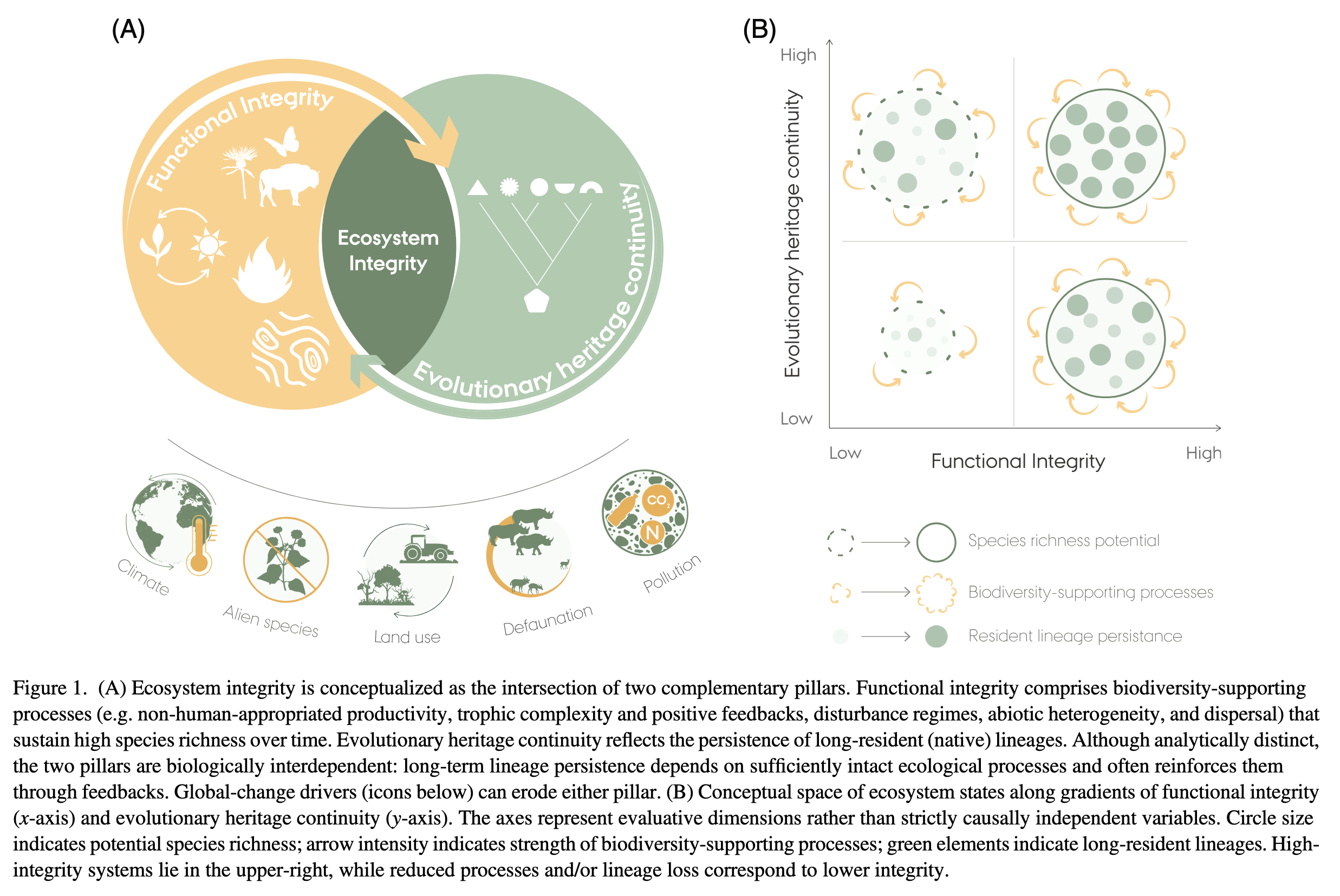
Transitions into novel ecosystem states are no longer the exception. We’re seeing widespread transformations across the planet. Models have suggested that over half of Earth’s land’s surface could be covered by novel ecosystems by 2100 due to climate change. And we know this ‘nonstationarity’ undermines how we manage infrastructure and ecosystems.
Recognising this, a lot of what we currently call “successful” restoration becomes questionable, because an ecosystem can look exactly like we want with all the right species but still be fragile, disconnected, and slowly eroding biodiversity.
Importantly, this new framing doesn’t abandon historical biodiversity, but it reframes how we think about it. Earth’s biota carries a rich evolutionary heritage, with most lineages formed under conditions very different from those we see today before humans messed with things: larger, more connected, more trophically complex, and influenced by diverse megafauna. Not things we typically think of with modern landscapes.
Many species retain these adaptations. But maintaining them isn’t about recreating assemblages that have passed, it’s about sustaining the processes that allow these lineages to persist. In other words, preserving evolutionary lineages is about maintaining functionally intact, dynamic ecosystems. These are the characteristics of resilient ecosystems that need to be prioritised in a rapidly changing biosphere.
Restoring processes, not snapshots
These processes won’t recreate themselves. We need to play an active role in pushing them towards higher integrity. As ecological novelty increases in the Anthropocene, the possible outcomes get more diverse. We’ve increased extinctions, facilitated the spread and impact of invasive species, and disrupted the rhythms of the planet. While this increasing novelty can erode ecosystem integrity, there’s no rule book to say we can’t play a role in increasing integrity at the same time. Sometimes we overlook the fact that present-day biodiversity, even biodiversity over recent human history, has already been subject to widespread defaunation.
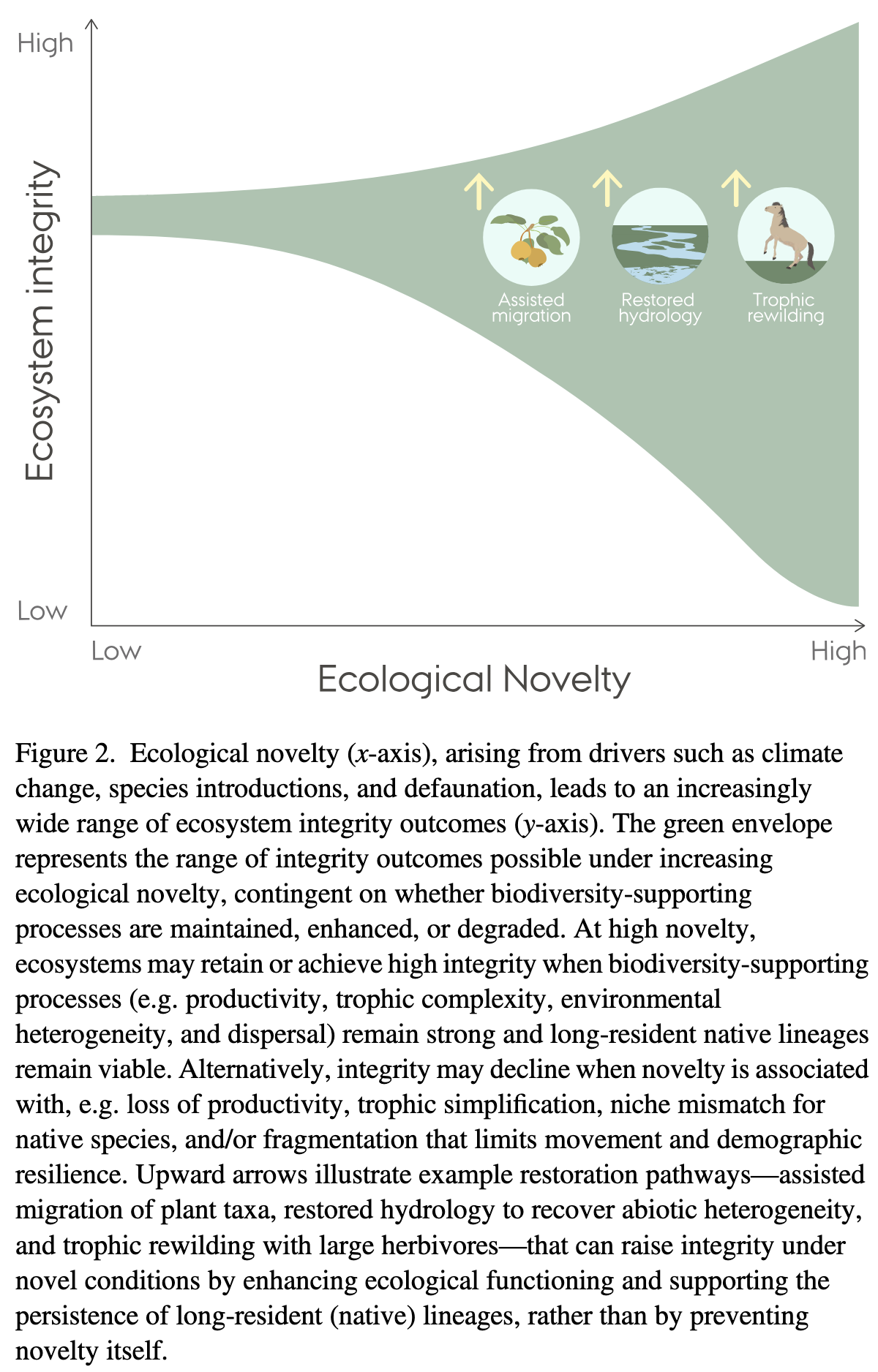
So our role should be to build resilience into ecosystems. And part of that means building more complex ecosystems. Most importantly, it means ensuring these complex ecosystems are connected enables the movement of species and energy among them. Ecosystems are inherently resilient, but that resilience depends on maintaining processes like dispersal, disturbance, and trophic interactions that allow them to reorganise and persist through change.
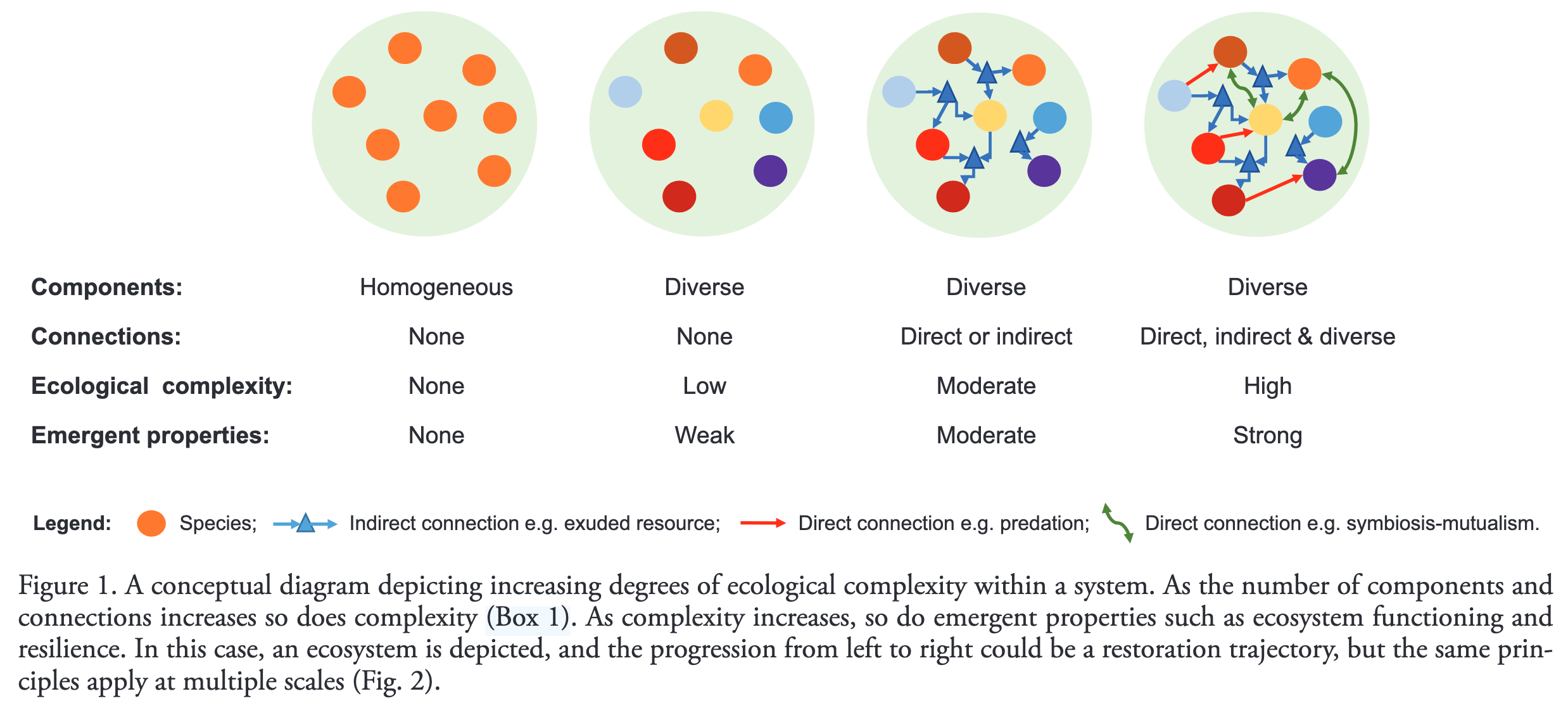
However, if we build complex ecosystems that prioritise recreating the past, there is a real risk they’ll fail no matter how well they function now. It’s important we prioritise the two pillars — if we do, novelty isn’t necessarily a problem.
Restoration begins to look different under this framing. It becomes more about rebuilding the conditions that allow ecosystems to function than creating an historical species list. It also means having some hard conversations — about what we’re willing to accept. Contentious topics around non-native species are hard to talk about, but their presence alone doesn’t determine integrity.
Of course, that doesn't mean every ecological change is desirable. Many novel ecosystems are heavily degraded. And many non-native species have massive impacts on ecosystems (what we call invasive species).
What matters is whether they support or undermine the processes and lineages we’re trying to sustain as ecosystems continue to undergo change.
Conclusions
Understanding history undoubtedly helps us make informed decisions about the future. It tells us of what ecosystems are capable of and what has been lost. But, as the world continues to change at pace, it cannot be our only guide.
In a rapidly changing world, we need resilient ecosystems — ones that function, persist and support life — not ones that look like the past, which may not cope with future conditions. Let’s not chase historical baselines.
Novelty doesn’t always have to represent degradation. By redefining what we mean by ecosystem integrity, we can help ecosystems continue to maintain important biodiversity-maintaining functions and safeguarding long-resident lineages.
Restoration needs to continue at pace, but it needs to be guided by more realistic principles.
If we keep measuring success against a world that won’t exist, it’s hard to escape the conclusion that we’re chasing ghosts.
What do you think? I realise this is a topic that may get your hackles up. Drop your thoughts in the comments.
Such a refreshing view. This is something I talk a lot about in my teaching. So if any of my students are reading this, it may sound familiar!
A good read - and exactly what rewilding is about. You're right, as both the terms restoration and conversation send the wrong message. Conservation is just straight-up wrong, as nature cannot and should not be conserved (i.e. canned, kept as is). And restoration might suggest restoring nature to a certain time in the past, as you write. But here at least I'd say that when rewilders talk about restoration, it is not that about restoring to a past baseline, but restoring biodiversity, the necessary wealth of flora and fauna to create a healthy ecosystem, whatever that future healthy ecosystem chooses to look like. Terminology is always a tough one - a single word can be used and misused, can be boon and bane.
This is excellent, Jonathan, a thoughtful balance between the necessity of fixing our mess and the reality that the mess is now larger than we are, across both time and space. I don't have any hackles up, but I worry that "redefining ecosystem integrity for an Anthropocene biosphere" will mean for some folks that we can move the goal posts closer to apathy... But as long as we have some integrity about redefining ecosystem integrity, we'll be on a better path.