

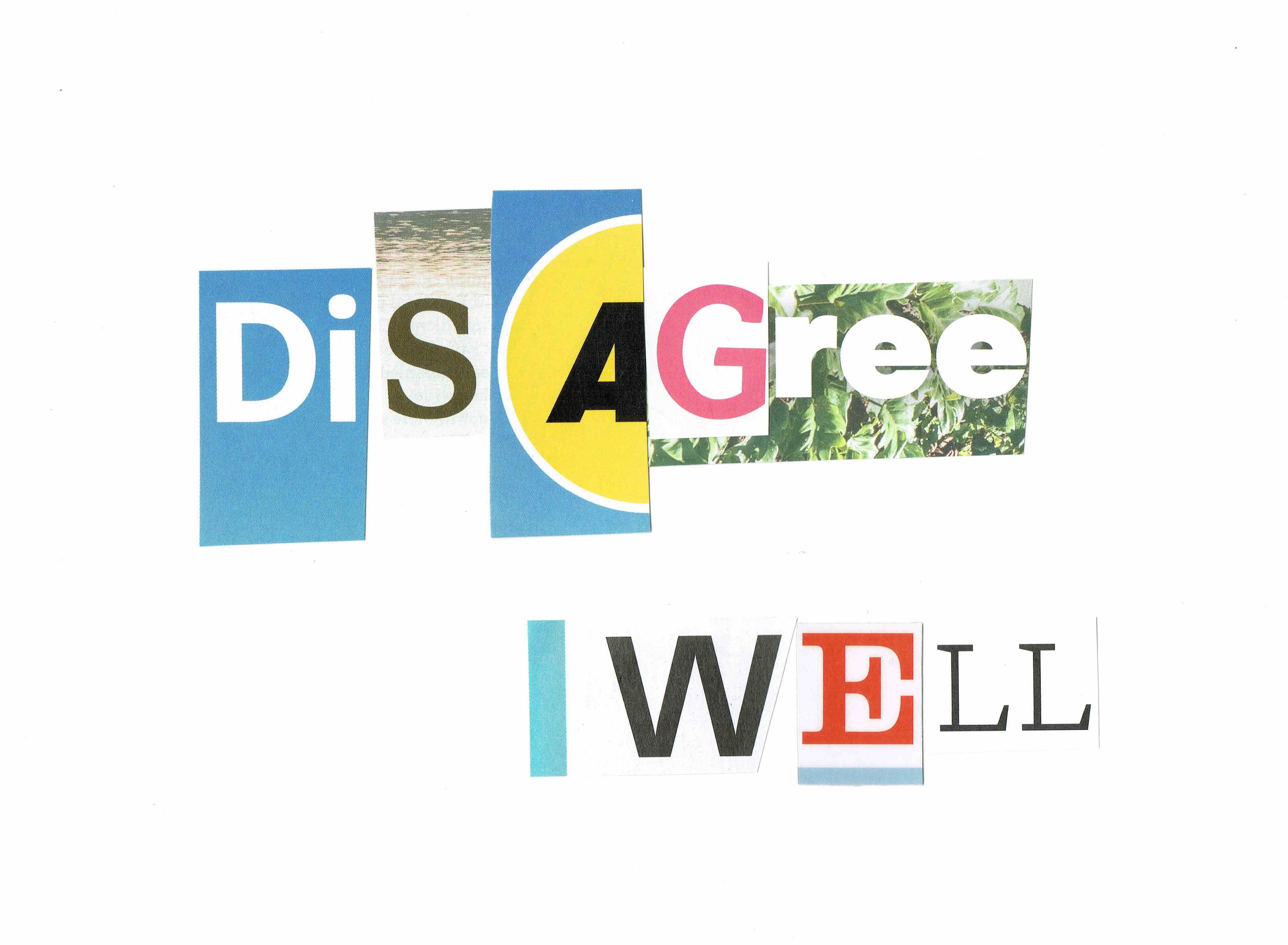
Disagree well
On curiosity, intellectual charity, and why we talk past each other

“One of the lessons I have learned from a long career is that controversy is a waste of effort. I take some pride in the fact that there is not one item in my bibliography that was written as an attack on someone else’s work, and I am convinced that the time I spent on a few occasions in reply–rejoinder exercises would have been better spent doing something else. Both as a participant and as a reader, I have been appalled by the absurdly competitive and adversarial nature of these exchanges, in which hardly anyone ever admits an error or acknowledges learning anything from the other. Doing angry science is a demeaning experience—I have always felt diminished by the sense of losing my objectivity when in point-scoring mode.”
The conversations we avoid
When was the last time you had a heated conversation about something important? Climate change is a surefire way to get disagreement. And we all know there are certain people you just do not talk about politics with!
But should we really be avoiding these conversations? They can be amazingly uncomfortable, but that’s often because we go in with our own views held strongly. What about if we went in with curiosity? To understand where the other party was coming from.
The nature of the modern world doesn’t help. We’re increasingly siloed and polarised, often only consuming things we already agree with, which can strengthen our positions and fortify our views. Talking across those divides — with your neighbours, colleagues, even the local checkout operator — can be challenging and uncomfortable, particularly when issues are aligned with political ideologies, such as climate change, biodiversity loss or social inequalities.
But avoiding these conversations is costly. Without engaging in them, we close the door to understanding — and without understanding, the door to progress begins to close too.
So when a paper came out recently on adversarial collaboration, an approach for scientists to work with those they fundamentally disagree with, I was immediately intrigued. Although the approach (more on that later) struck a chord with me, what really stood out was that it put language around something I believe we all sense: that disagreement becomes productive when we replace point-scoring mode with curiosity.
Curiosity as an alternative
Disagreements are all well and good between you and your neighbour but what about when the stakes get a bit higher? Regardless of the arena, the same issues apply — sides are picked, ideas are fortified, and the worst version of arguments are picked on. Much of the polarisation of society — left vs. right, blue vs. red — has emerged from caricatures of what we think the other side believes in.
The problem isn’t disagreement. Disagreement is a cornerstone. The problem is when we stop trying to understand why someone holds the view they do. It doesn’t matter whether it’s in politics, science, or social media, if disagreement is based on defending identities rather than understanding claims, learning is impossible.
Instead of exaggerating and distorting, if we started by trying to understand the best version of our adversary’s ideas, conversations that get blood boiling begin to soften. It’s a whole different type of conversation then.
In short, let’s be intellectually charitable.
Starting with curiosity like this reshapes the possible directions in which conversations can go. Instead of an intellectual dead end where the only way out is to walk away, these conversations open intellectual doors and can deepen ties.
This isn’t just an abstract ideal. Daniel Kahneman, the famous psychologist who introduced adversarial collaborations, reflects on how his adversarial collaborations always “ended with some new facts accepted by all, narrowed differences of opinion, and considerable mutual respect”.
Adversarial collaboration in science is a way to flip the script away from “angry science”, as Kahneman called it, which can play out in cycles of back-and-forths between authors in a series of letters that lead to no advancement and wasted time and effort. Rather than taking an intellectually charitable approach, these disagreements often target the weakest arguments. And most importantly, no one changes their mind.
Sound familiar?
Adversarial collaboration, on the other hand, focuses on working together to cooperatively examine differences in good faith without the pressure of reaching a resolution at the end. Forcing consensus isn’t the goal, the power of adversarial collaboration is that it makes the nature of disagreement explicit.
This sounds like a recipe for healthy, productive conversations.
We’ve all seen the alternative: a one-sided presentation of “facts”, arguments based off one study, stories shaped entirely by cherry-picked data. These sorts of one-sided pieces sell. People love to read things that reinforce their worldviews. But they oversimplify the messy realities of the world. This is not intellectual charity. It’s uncharitable.
Why we talk past each other
Sometimes arguments go nowhere because people are disagreeing about different things.
Ecology offers an extreme version of this problem: systems are so context‑dependent that entrenched views can form even among people arguing in good faith.
Remember those times you forget why you’re even arguing in the first place? It might be simply because you’re disagreeing about entirely different things.
These seemingly intractable disagreements, particularly in science, are often because we’re arguing at different levels without even realising. Some disagreements are about what exists in the world, others how we should know things, others still about what we mean by the words we use. Philosophers of science call these ontological, epistemological, and semantic disagreements. The labels don’t matter, but they help us to realise there are many ways to find disagreement, and for that matter, agreement.1
So, next time you’re in such a situation, remember that no amount of debate will resolve a disagreement unless you get to the root cause of it. You may be having different kinds of disagreements at the same time.
Disagreeing well starts by recognising what kind of disagreement you’re actually having. You never know, your stubborn adversary may not be so stubborn after all.
Only then can curiosity replace frustration.
Your choice
Disagreeing and debating don’t need to be heated, angry encounters. Disagreeing well — whether in everyday life or in science — requires curiosity and intellectual charity. Often, conflicts persist because people are arguing about different things, not because anyone is acting in bad faith.
What can I learn from this person? Is there any truth to what they’re saying?Am I being narrow minded, myself? These are all questions we should be asking ourselves when entering into such conversations. Doing so will surely drive better outcomes.
At the end of the day, disagreeing well is a choice. We can choose to clutch tightly to our long-held views or stay open to learning. We can choose to score points or to understand. And we can choose to get angry and walk away or remain curious.
I know which path I’d choose.
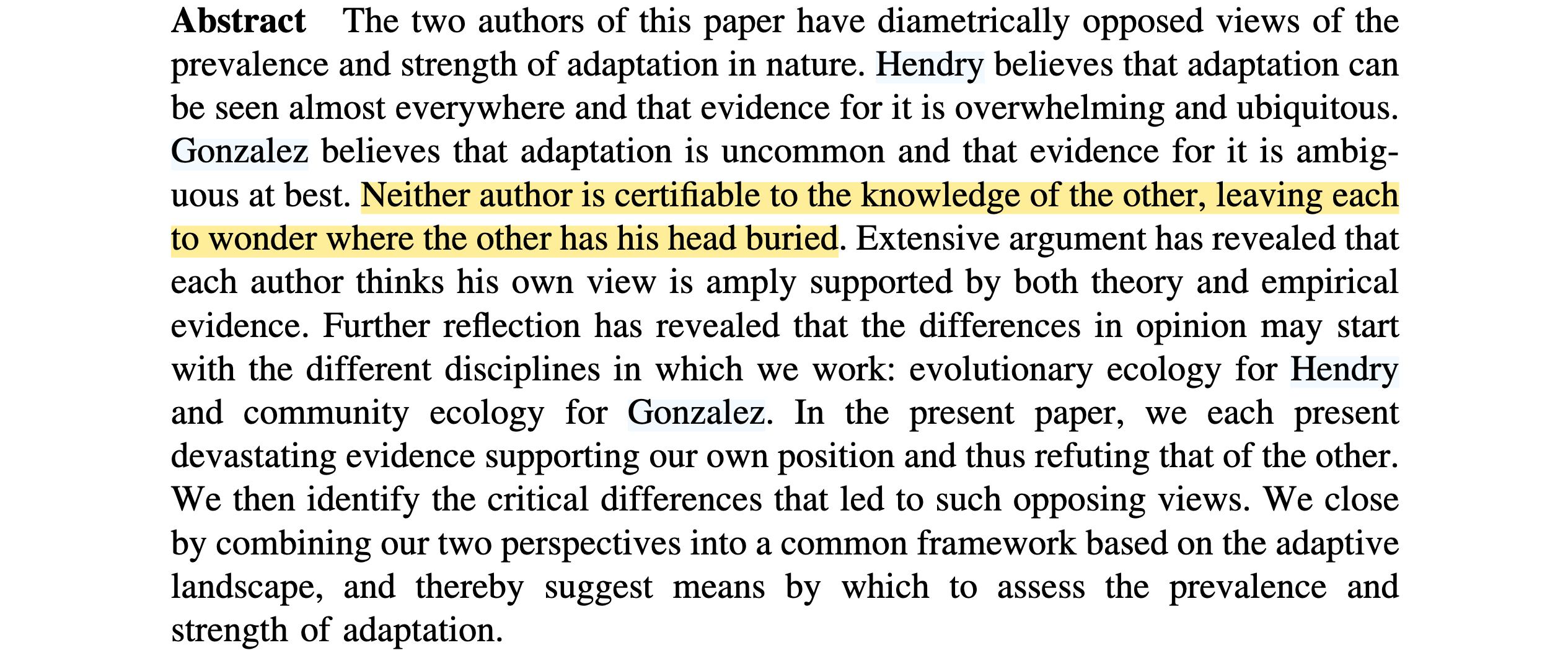
If you’re a bit of an eco-evo geek like me, check out this fun back-and-forth between Andrew Hendry and Andy Gonzalez on the prevalence of adaptation in the wild. They come at this from primarily evolutionary vs ecological angles.
Thanks again Jonathan for another thought provoking piece. I would like to suggest an extension to your discussion.
I read the piece on adversarial collaboration with a mixture of admiration and unease; admiration because it articulates something profoundly hopeful about human
disagreement, and unease because I kept thinking: we don’t explicitly teach children to do any of this.
We tell them to “be kind”, “take turns”, “listen”, but rarely do we show them how to stay curious when someone says something they don’t like. We don’t teach them how to sit with discomfort, or how to ask a question that isn’t a trap, or how to recognise when a disagreement is about facts, or methods, or simply the meaning of a word. Yet we expect them, as adults, to navigate climate debates, political polarisation, and the emotional minefields of modern life with grace.
It’s a bit like expecting someone to play the violin beautifully without ever handing them an instrument.
Imagine watching some older secondary age young people argue about whether wolves should be reintroduced into the UK. One is armed with YouTube facts; the other with a David Attenborough documentary and a fierce loyalty to hill sheep farmers she had learned about. It has all the makings of a stalemate.
But then something unexpected happens.
One of them pauses and says, “Hang on, are we arguing about whether wolves are dangerous, or whether farmers would lose money?”
The other blinks, thinks for a moment, and replies, “Oh. I was talking about danger.”
Just like that, the temperature drops. They’re not suddenly in agreement, but they are in the same conversation. They’ve found the level of disagreement, the thing the article calls the ontological, epistemological, semantic tangle, without ever needing the vocabulary.
Children can do this. They just need the space.
Curiosity isn’t soft, it’s a discipline.
The article argues that disagreement becomes productive when we replace point scoring with curiosity. That’s true, but curiosity isn’t a mood, it’s a practice: it’s something we can teach.
Imagine if classrooms treated curiosity the way sports coaches teach football skills:
* How to ask a question that opens a door rather than slams one?
* How to listen for the strongest version of someone else’s idea?
* How to say “I might be wrong” without feeling diminished?
* How to recognise when you’re arguing about different things entirely?
These are not “nice extras”. They are the foundations of democratic life. Children already see the adult world modelling the opposite. They watch us dodge difficult conversations at family gatherings. They hear the brittle certainty of talk‑radio callers. They see online arguments where nobody changes their mind, because changing your mind has become a kind of social death. If we want children to grow into adults who can disagree well, we have to give them a counter‑example, a place where disagreement is not a threat but an invitation. Schools can be that place.
Kahneman’s idea of adversarial collaboration sounds lofty, but it’s perfectly suited to a classroom. Children are natural experimenters. They love puzzles. They’re less invested in identity than adults. They can work together on a shared question even when they start from different assumptions.
Climate change, biodiversity loss, social inequality, these are not issues that will be solved by people who only talk to those who already agree with them. They require citizens who can stay in the room when things get uncomfortable. Who can say, “Tell me how you see it,” and mean it. If we want that future, we have to start early.
The article ends by saying that disagreeing well is a choice. I’d go one step further: it’s a choice children learn by watching us. If we want them to choose curiosity over certainty, understanding over caricature, and dialogue over division, then we need to model those choices, in classrooms, in staffrooms, in the quiet corners of school corridors where the real education often happens. Because the truth is simple:
children will inherit our disagreements.
The least we can do is teach them how to handle them with grace.
Quote I've found useful in this context. "Belief is the death of intelligence " Robert Anton Wilson