

The most important discoveries can take decades — or a millennium
From Kyoto's cherry blossoms to the Keeling Curve, the power of thinking beyond a single lifetime

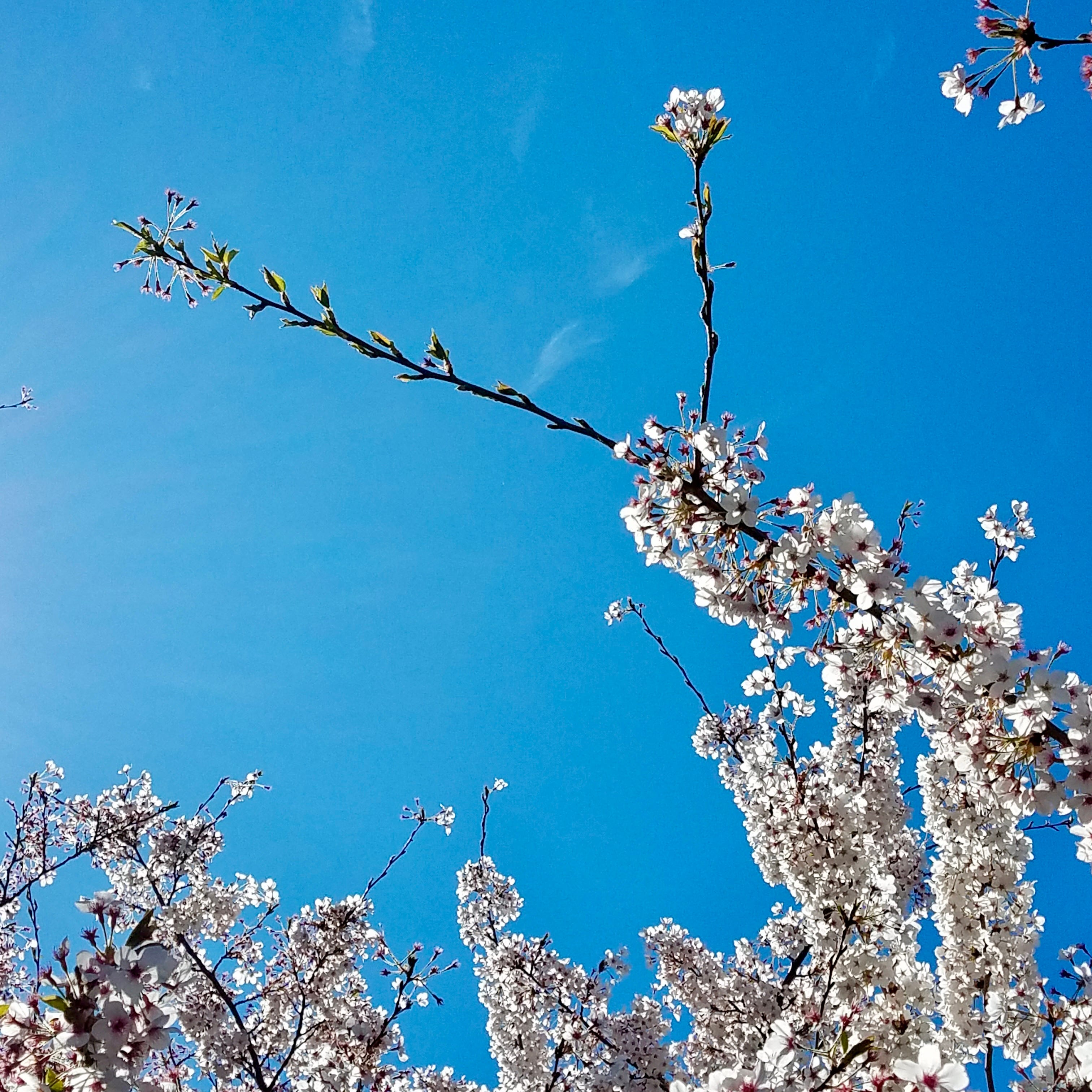
A Japanese professor by the name of Yasuyuki Aono passed away from cancer in 2025. His passing caused widespread concern, because he was the custodian of one of the most phenomenal datasets on the planet.
Aono spent much of his career collating data on the peak flowering dates of cherry trees (Prunus jamasakura) in Kyoto, Japan. He learned old forms of Japanese so he could read records dating back to the 9th-century, helping him to build a 1200-year record of this critical seasonal phenomenon.
Thankfully, following a search by Tuna Acisu, a data scientist at Our World in Data who hosts the dataset, the 1200-year record is once again in safe hands in the form of Dr. Genki Katata, a former collaborator of Professor Aono.
Every spring, photographers rush to capture Japan’s cherry blossoms. Their famous cherry blossom season generates somewhere around $9 billion annually through tourism. The flowering of these trees has been so regular that festivals, school calendars, and family gatherings have been built around their expected arrival.
But this long-term record reveals something impossible to see in a single lifetime: we now know that peak flowering arrives approximately two weeks earlier than it did during the first thousand years of the record. That wouldn’t have been possible without the commitment to measuring something beyond your lifetime.
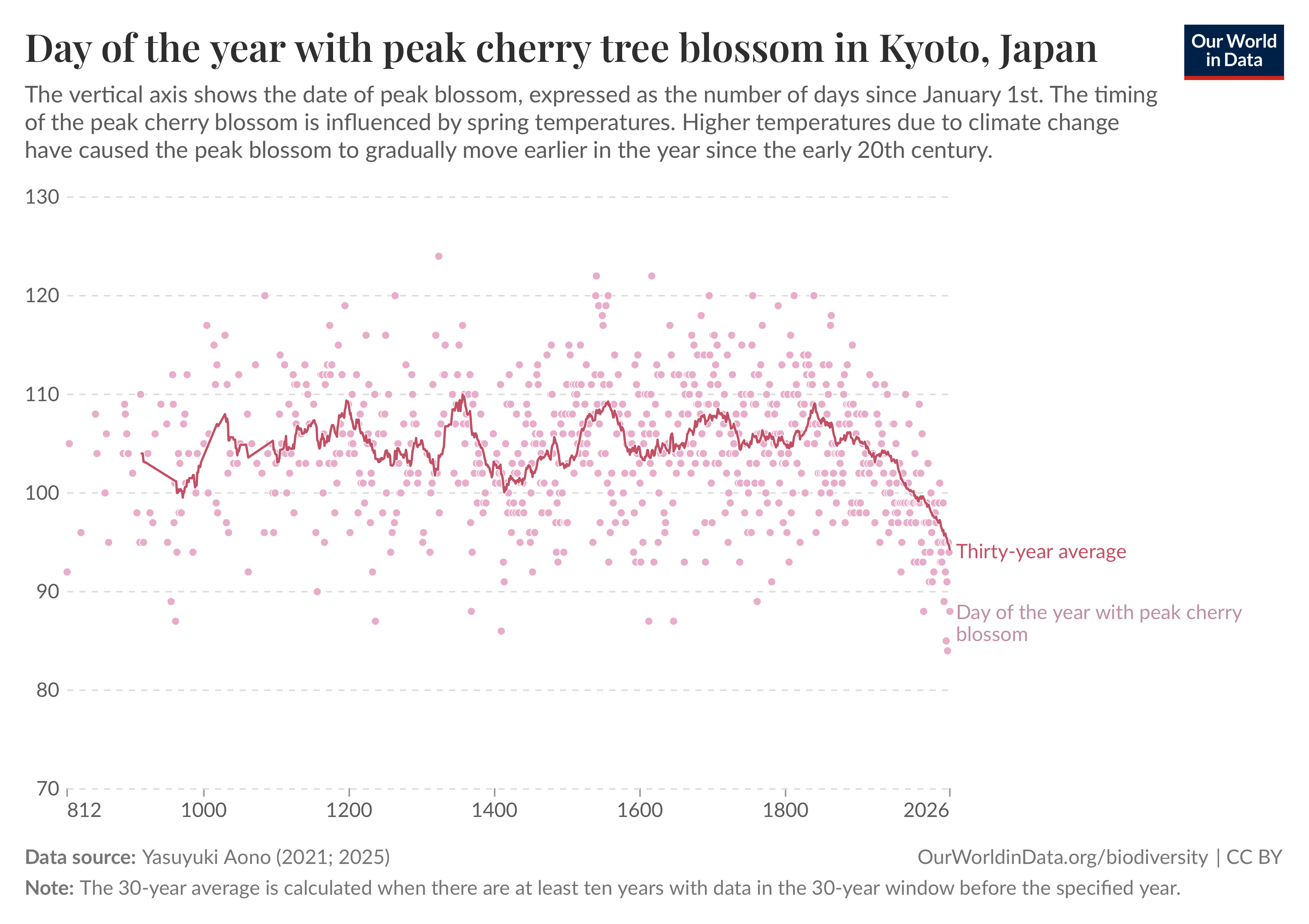
We already know enough to act on it. Festivals can be rescheduled around a bloom that arrives earlier than it used to, but this recalibration is only possible because someone was measuring it in the first place.
The story of Japanese cherry blossoms isn’t unique. Again and again, some of humanity’s most important discoveries emerged not from new technology or fancy new data analysis techniques, but from patience.
I write a lot in this newsletter about time — about how seemingly at odds we are with the natural cycles of the planet. Electoral cycles, fast fashion, quarterly reporting: almost everything we build resets every few years or less. Aono’s record stands in stark contrast, built from a thousand years of writing nobody intended to be used as data, by a man curious enough to seek it out and patient enough to curate it.
Data can teach us more than we set out to learn
Lake Suwa, also in Japan, freezes over most winters, and when it does, the ice cracks into a ridge that Shinto priests have called omiwatari — the god’s crossing. According to legend, the god Takeminakata walks the ice each winter to visit a shrine on the far shore, and the ridge is his footprint. Priests have recorded the timing of this phenomenon since 1443.
In Finland, the Torne River has historically played an important role in trade, transportation, food, and recreation. Because of this, in 1693, a Finnish merchant named Olof Ahlbom began recording the date of the river’s ice breakup in Spring. Although Ahlbom’s record was temporarily interrupted when he fled Russian troops during their occupation, he resumed it thereafter and it has been continued by others ever since.
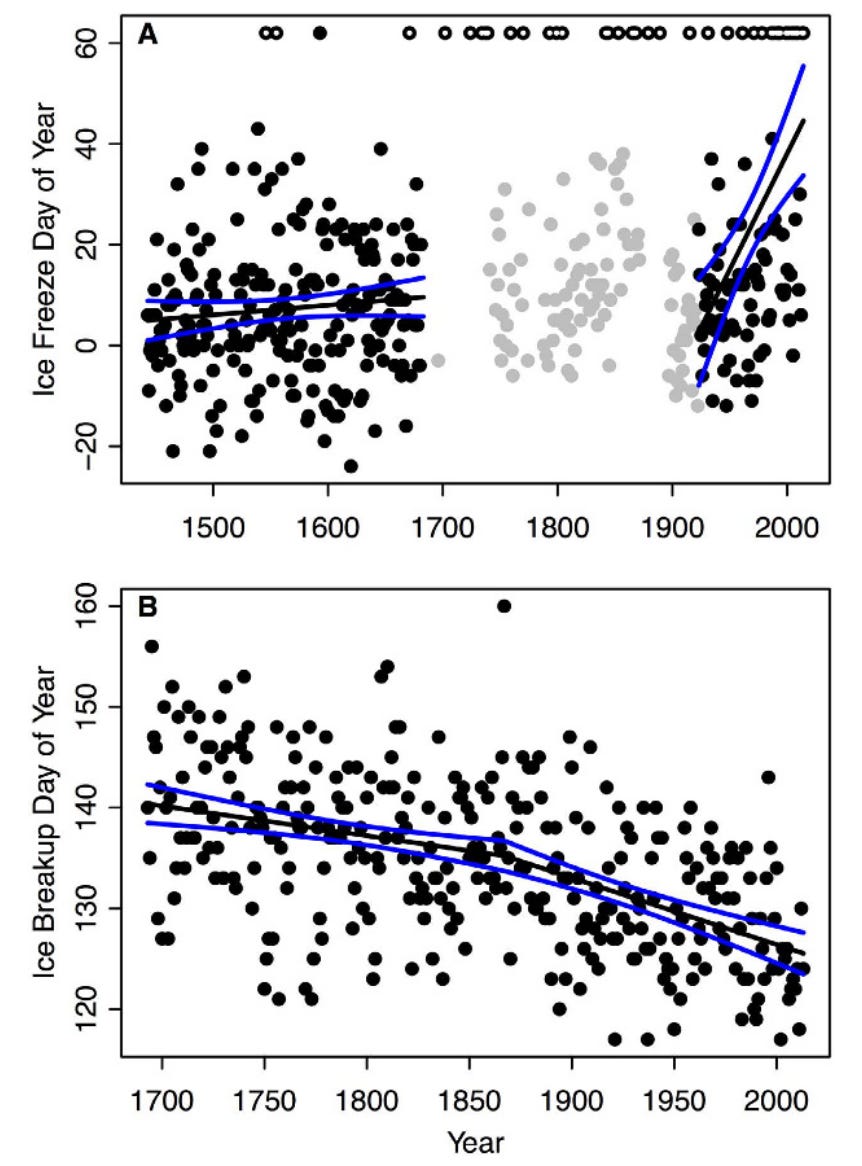
What both of these datasets have taught us, much like the Japanese cherry blossom data, is that long-term data can reveal things far beyond what they were initially intended for. All three datasets have become powerful evidence of how climate change is disrupting the natural rhythms of the planet. In this case, ice is freezing increasingly later or not at all in Lake Suwa, and ice breakup is occurring increasingly earlier in the Torne River.
And this topic isn’t just something I observe from the outside — most of my own group’s research runs on data other people or organisations collected for entirely different reasons. For instance, a 30-year river monitoring programme in New Zealand has helped us uncover everything from the importance of environmental rhythms in ecological communities to evidence that those communities are becoming increasingly homogenised through time.
What about the records people built on purpose?
The above examples highlight how we can learn surprising things from records that weren’t initially meant for science. But sometimes people deliberately commit to measuring something for decades, creating records that become more valuable with every passing year.
Perhaps the most famous example of this is the Keeling Curve. In 1958, Charles Keeling began measuring atmospheric carbon dioxide at Mauna Loa Observatory in Hawaii.
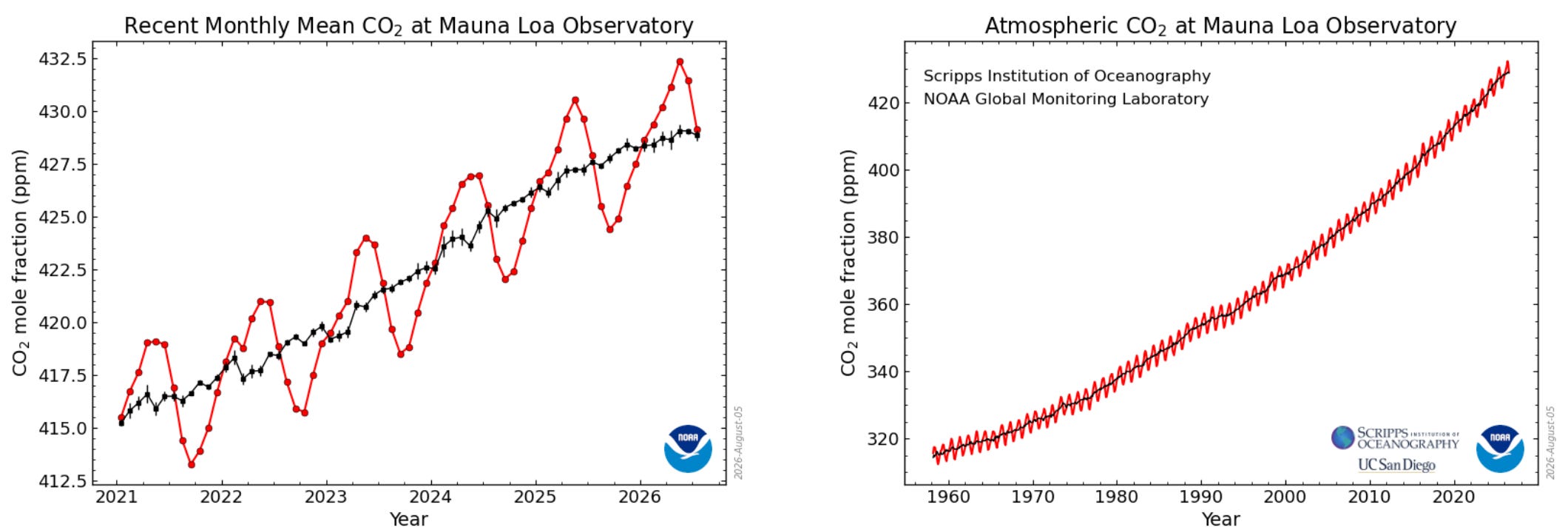
At the time, it was unknown how atmospheric carbon dioxide would change from year to year, let alone how rapidly it would increase. But Keeling’s measurements continued to stack up: day after day, year after year, decade after decade. The result is one of the most important and widely used scientific records in history. The graph has become one of humanity’s clearest pieces of evidence that we are fundamentally altering the atmosphere, and the climate as a result.
Aono’s cherry blossoms revealed climate change by accident, whereas Keeling measured it directly. Both of these examples required people who were willing to keep collecting data long after its novelty faded.
Beyond a single lifetime
In 2025, the Mauna Loa observatory was on the chopping block as a result of widespread budget cuts rolled out by the US government. Thankfully, it survived. But this was an example of just how vulnerable these long-term programmes can be. And how at the mercy they are of myopic leaders.
The most striking feature of these datasets is not what they tell us, but that they tell us something at all. Every example I’ve given here required someone willing to do labour that they might not see the fruits of. In one way or another, the data they collected revealed its true value decades or centuries later — and sometimes for a reason completely unrelated to why collection was initiated.
Charles Keeling would never see the full trajectory of the curve with his name on it. Aono’s, by contrast, unearthed a record that began centuries before he was born, but even he could not know how the cherry blossom story would end.
One thing is clear. None of these records survived because people knew exactly what they would reveal. They survived because someone, whether across generations or centuries later, decided the thread was worth keeping alive, or worth finding again.
One more thing
Our very first monthly Predirections Office Hours is next week — an unscripted, 1-hour live Zoom conversation: a space to talk through questions, ecological ideas, recent posts, half-baked research ideas, something you disagree with.
This newsletter runs on the same logic as everything above: it only continues if enough people decide, year after year, that it’s worth keeping going. If it’s been useful to you, here’s how to be one of those people — and paid subscribers get first access to the call.
Community Patron ($20/year; $2/month).
Supporting Patron ($60/year; $6/month) (recommended).
Founding Patron ($100/year; $10/month).
Time:
Los Angeles (PDT): 2:00pm, Wednesday 12 August
Denver (MDT): 3:00pm, Wednesday 12 August
New York (EDT): 5:00pm, Wednesday 12 August
London (BST): 10:00pm, Wednesday 12 August
Berlin/Paris (CEST): 11:00pm, Wednesday 12 August
Singapore (SGT): 5:00am, Thursday 13 August
Sydney (AEST): 7:00am, Thursday 13 August
New Zealand (NZST): 9:00am, Thursday 13 August
(Note: If the time zone doesn’t align with your schedule, no worries — I’ll be sending out the full recording and summary to all patrons afterward.)
It might not have been your intention when writing this, but the line "None of these records survived because people knew exactly what they would reveal. They survived because someone decided the thread was worth keeping alive." Started my wheels spinning.
I've been asking myself for a long time how can we teach people to live at the pace of the natural, real world? Lightning exists for a moment, a fruit fly lives for a few days, a flower blooms for a few weeks, a gust of wind can chase low pressure systems for months.
And that one line suggests that maybe we do it by teaching people to embrace unspecific desire rather than hyperfocused exact expectation.
We've tried having a world where pressing a button has a predictable and specific desire fulfilled immediately. And this need for immediate specificity is destroying so much.
Maybe we're better off just embracing the variable temporality of the unspecific desire to keep threads alive.
Absolutely lovely post. I have thought about this in other regards… it’s like planting trees or restoring soil. Both take a long time to come to fruition. You don’t necessarily do it for yourself. You do it because it should be done.